CAP Conference Day 2 Report
By UAWRegion 8 Webmaster John Davis
Day 2 of the 2006 UAW CAP Conference began
promptly at 8:45AM, with a very full day of speakers and events. The
day began with an update on the 2006 UAW Legislative priorities by Legislative
Director Alan Reuther. (click here
for details on each issue)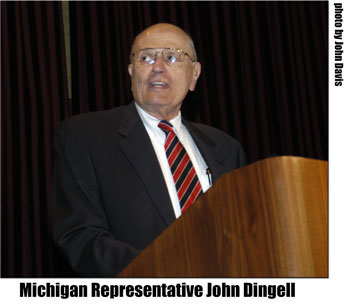
Thailand Free Trade
“We have a list of priorities this year, with the Free Trade Agreement
for Thailand being a major issue,” Reuther stated. “In 2005
Thailand built over 1,000,000 vehicles with 60% of those being pickup
trucks. Many of the Japanese manufacturers have relocated their truck
production to Thailand.
The Bush Administration has set a priority of completing a free trade
deal with Thailand this year that will eliminate or reduce the current
import tariff. With the Fast Track authority, Congress would either
vote this trade deal up or down without and opportunity to make changes,
and you should remember that Congress has never voted down a Fast Track
deal. If these tariffs are lifted then 42,000 UAW assembly jobs and
another 50,000 UAW component jobs could be in jeopardy. When you are
on the Hill tomorrow, make certain that you encourage your elected representatives
to use whatever influence they have with the Bush Administration to
maintain import tariffs on pickup trucks from Thailand. Japanese manufacturers
would simply use Thailand to back door there vehicles here without allowing
us to ship there.”
Employee Free Choice Act
Another important piece of legislation is the Employee Free Choice Act.
This legislation has been introduced to help restore workers right to
join a union. The National Labor Relations Act of 1935 gave workers
this right, but over the past five years worker’s rights to organize
have been eroded. Here are a few facts about the current state of organizing:
- In 25% of organizing drives employers will fire at least one employee
to strike fear in the others. This is illegal.
- In 92% of organizing drives, employers will hold “captured audience”
meetings to pressure  employees
to resist union representation.
employees
to resist union representation.
- In 78% of organizing drives, employers will hold one-on-one meetings
with employees to pressure them to vote against union representation.
Senators Ted Kennedy and Arlen Specter and Representatives George Miller
and Peter King have introduced the bill to restore the right of workers
to organize. To date, 42 Senators and 207 Representatives have already
co-sponsored this labor law bill.
Tax Fairness
There are many issues surrounding taxes that need our attention. Additional
tax cuts for the wealthy are being touted, while new taxes for workers
are being discussed. The Bush Administration is interested in pushing
new tax cuts for investment, that would reduce those rates lower than
ones on wages. Plus, the Bush Administration believes that workers whose
benefit packages exceed $5,000 a year should be viewed as taxable income.
This would place an additional burden on workers. The President also
talked up his idea of Health Savings Accounts during the State of the
Union Address. This proposal would encourage employers who offer benefit
plans to dump them or shift additional cost to workers. The UAW strongly
opposes any move to shift benefit cost to workers.
Pensions
In addition to being opposed to benefit plans, the Bush Administration
also is against defined pension plans such as the ones offered in most
union contracts. They are proposing phasing these plans out and replacing
them with employee contribution plans.
Marshall Plan for US Automotive Industry
The President continues to state there will be no bailout for the American
Automotive industry. However, no one from the industry has asked the
government to do so. But, there are many things the government could
do to level the playing field for domestic automotive manufacturers.
The government could offer help in retooling and updating existing facilities
much like has been done to woo many of the transplants that have located
here. We are the only industrialized nation in the World without some
type of government assisted and regulated health care plan. A single
payer system could help ease the cost of providing fair benefits to
the employees of the American automotive manufacturers.
The conference continued with a media panel made up of Harold Meyerson
of the Washington Post, David Corn, Washington Editor for The Nation
and Al Hunt, Washington Bureau Chief for Bloomberg News.
Next Michigan 15th District Representative John Dingell addressed the
conference. “There is a lot of misinformation going around this
town about the auto industry and the problems it is facing,” Representative
Dingell stated. “Some say the auto industry wants a bailout and
that is not true. Others blame unions and the standard of living they
have created for workers for the auto industry problems and that is
not true either. Our automotive industry sees a $10,000 per vehicle
disadvantage through unfair trade policies and restrictions from other
countries.
All the President can offer is that Detroit must “build revelenat
vehicles. I have news for him, if he would get out of the White House
and go to the auto show in Detroit he would see that you build the best
cars and trucks in the world. What our automotive industry needs is
a fair and level playing field. If this were the case, then our workers
could compete with anyone in the world. It is up to the government to
provide this playing field and they have failed to do so. Take China
for example, they come over here and are polite when we question them
about living up to their commitments on goods exported to China. But
we read in the Bible that “you shall know them by their deeds.”
Being polite about our questions but doing nothing to correct the problems
is no good. In Korea they test the windshield of American made imported
vehicles with a hammer. Plus, if you buy an American made imported vehicle,
you get audited by Korea’s version of the IRS. Is that fair?
Then if you look at the current National Labor Relations Board you find
the most unfriendly board to labor in our country’s history. They
worked toward keeping unions out. They attack you when labor is responsible
for Social Security, benefit plans, pension plans and health and safety
in the workplace. You have made the difference for all American worker’s
whether they belong to a union or not.”
Following Representative Dingell’s address, each Region broke
off for a lunch meeting on their own. Region 8 Director Gary Casteel
welcomed the Region 8 delegates and introduced the key note speaker
for the meeting Alabama Representative Artur Davis. Congressman Davis
has made quite a name for himself in just four years in Washington and
has proved to be a vital friend to working people. He has an excellent
voting record with labor and is very involved in the issues that working
class Americans face. Growing up in Montgomery, Representative Davis
attended Harvard University on an academic scholarship and finished
his law degree with honors. For
more on Representative Davis’s address click here.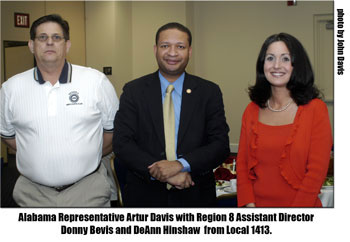
Following lunch the conference reconvened with an address by National
Chair of the Voting Rights Institute Donna Brazile. Ms. Brazile has
served as campaign manager for a number of political races, including
the Clinton/Gore ticket. Click
here for more on her speech.
Next was another panel discussion with the subject being the economy
and taxes. Economic Policy Institute President Lawrence Mishel and Robert
McIntyre of the Citizens for Tax Justice provided the commentary. “A
person who takes an entry level job today starts at 25% less than they
would have in the same job in 1980 once we adjust for inflation,”
Lawrence Mishel states. “Plus, in 1980 there was a 75% chance
that job would include employer provided health care benefits. Today,
that chance has fallen to just 30%. 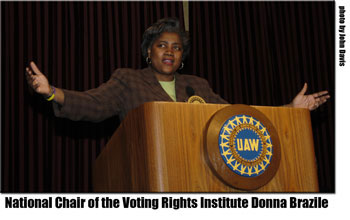
The Bush Administration has overseen the lowest job creation rate since
the depression. At the same time, we have seen tax cuts of 2.2 trillion
dollars with over 50% of that going to the wealthiest 1% of the population.
Now he his proposing 1.8 trillion more with the bulk of that headed
to the wealthiest 1% as well. We continue to provide more and more tax
cuts to the wealthy while we cut more and more programs that benefit
working class people.”
The order of the conference had to be adjusted on Monday afternoon.
Many of the speakers scheduled for Tuesday, had to move their visit
due to the funeral of Coretta Scott King on 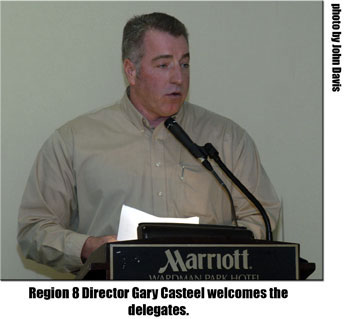 Tuesday.
President Bush decided to attend the funeral, which meant delays and
disruptions to the airport in Atlanta. Representative Jan Schakowsky
moved her address to Monday afternoon, and the update on the Delphi
situation by Vice-President Richard Shoemaker was moved until Tuesday.
Tuesday.
President Bush decided to attend the funeral, which meant delays and
disruptions to the airport in Atlanta. Representative Jan Schakowsky
moved her address to Monday afternoon, and the update on the Delphi
situation by Vice-President Richard Shoemaker was moved until Tuesday.
The conference ended with another panel discussion on Civil Rights with
panelist Wade Henderson of the Leadership Conference on Civil Rights
and Jocelyn Frye of the National Partnership for Women and Families.
Highlights for Tuesday include a panel discussion by members of the
Democratic Legislative Campaign Committee, Democratic Congressional
Campaign Committee and the Democratic Senatorial Campaign Committee.
Democratic National Committee Chair Howard Dean is scheduled to address
the conference. In the afternoon, delegates will head to Capital Hill
to meet with our elected representatives.



